
Understanding the 3. Liga Tabelle: Format, Rules, and Promotion Paths
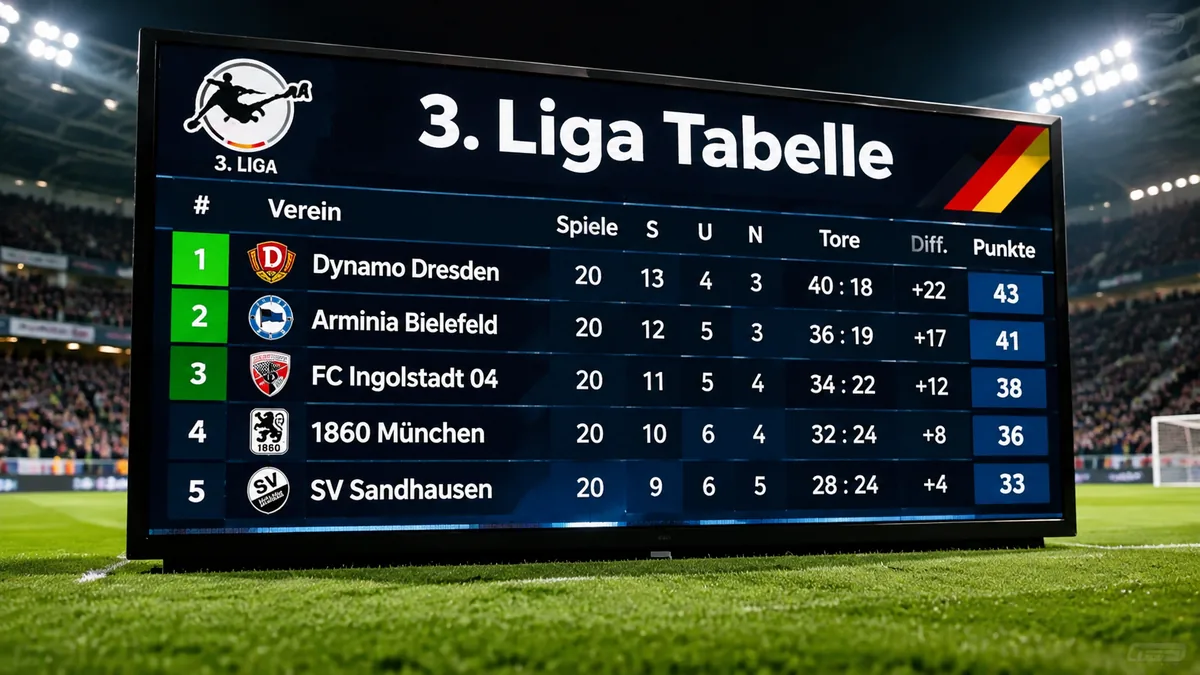
Tracking points in German third-tier football becomes confusing when rapid matchday shifts alter promotional races instantly. Missing key rules regarding goal differences or reserve team limits leaves supporters misinterpreting real standings.
This master guide clarifies every detail of the 3. Liga Tabelle, explaining official DFB tie-breakers, playoff formats, and relegation rules through simple data tables.
League Framework and Matchday Point Rules
The third tier of German football operates on a balanced round-robin format managed by the national association. Twenty professional clubs battle across nine months to earn league placement and national broadcasting revenue.
| League Metric | Operational Parameter | Detail Specification |
| Total Participating Clubs | 20 Professional Teams | Full national footprint across Germany |
| Total Matchdays | 38 Fixture Weeks | 19 home matches and 19 away matches per club |
| Points for a Win | 3 Points | Awarded to the winning team at full time |
| Points for a Draw | 1 Point | Awarded to both clubs if scores are level |
| Points for a Loss | 0 Points | Received by the defeated club |
| Season Duration | August to May | Includes a short mid-winter break in January |
Evaluating the active 3. Liga Tabelle requires tracking total points gathered alongside cumulative goal margins. Consistency across all 38 matches dictates whether a club achieves promotion or faces relegation.
Automatic Promotion Zones for Top Contenders
Finishing near the top of the division provides direct access to the second tier of German football. The upper section of the standings features two automatic promotion berths that eliminate post-season uncertainty.
| Table Rank | Designation | Post-Season Outcome |
| 1st Place | League Champion | Automatic Promotion to 2. Bundesliga |
| 2nd Place | League Runner-Up | Automatic Promotion to 2. Bundesliga |
Clubs reaching these two positions avoid elimination matches entirely. Securing an automatic spot allows management teams to prepare early for higher competition levels and increased media revenues.
The Third-Place Promotion Playoff Breakdown
The third spot on the table creates a high-stakes, two-legged qualification series against a higher-tier opponent. This fixture pair determines which club fills the final opening in the second division.
| Playoff Parameter | Structural Rule | Execution Format |
| Participating Teams | 3rd Place (3. Liga) vs 16th Place (2. Bundesliga) | Home-and-away aggregate score format |
| First Leg Host | 3. Liga Third-Place Club | Hosted at the lower-division stadium |
| Second Leg Host | 2. Bundesliga 16th-Place Club | Hosted at the upper-division stadium |
| Tie-Breaker Method | Extra Time (30 mins) then Penalty Shootout | Away goals rule is no longer active |
Winning this playoff secures promotion, while losing keeps the club in the third division for another campaign. The competitive gap between these divisions makes this series intense for both fanbases.
The Four-Team Relegation Danger Zone
The bottom section of the table features severe penalties for underperforming clubs. Four organizations lose their professional status each year based on final league positions.
| Relegation Position | Status | Immediate Season Outcome |
| 17th Place | Relegation Zone | Demotion to Regional Amateur League |
| 18th Place | Relegation Zone | Demotion to Regional Amateur League |
| 19th Place | Relegation Zone | Demotion to Regional Amateur League |
| 20th Place | Relegation Zone | Demotion to Regional Amateur League |
Clubs in these positions leave professional football structures entirely. Reading the 3. Liga Tabelle carefully during spring matchdays reveals which teams face financial restructuring in lower regional divisions.
Official DFB Tie-Breaking Hierarchy
When two or more clubs collect equal total points, strict criteria determine exact table ordering. The Deutscher Fußball-Bund (DFB) enforces a sequential five-step evaluation process.
| Priority Level | Tie-Breaking Criterion | Application Rule |
| 1st Criteria | Goal Difference | Total goals scored minus total goals conceded |
| 2nd Criteria | Total Goals Scored | Team with higher total goals scored ranks higher |
| 3rd Criteria | Head-to-Head Results | Direct match results between the tied teams |
| 4th Criteria | Head-to-Head Away Goals | Away goals scored during direct matches |
| 5th Criteria | Total Away Goals Scored | Total away goals scored across all 38 matchdays |
Goal difference serves as the primary tie-breaker throughout the season. Defensive stability often decides promotion races or relegation survivals when point tallies remain identical.
Historical Point Targets for Championship, Safety, and Survival
Historical competition data provides reliable benchmarks for clubs aiming at specific seasonal outcomes. Analyzing past seasons establishes clear targets for managers and analysts.
| Target Outcome | Average Points Needed | Historical Min/Max Range |
| Automatic Promotion | 71 Points | 68 – 78 Points |
| Promotion Playoff Spot | 65 Points | 61 – 69 Points |
| Mid-Table Safety | 48 Points | 45 – 52 Points |
| Relegation Avoidance | 45 Points | 41 – 47 Points |
Crossing the 45-point mark generally protects a team from falling into the bottom four places. Reaching 70 points almost always secures automatic passage to the second division.
Special League Regulations for Reserve Teams
Development squads owned by upper-tier clubs compete under specific operational rules within the division. These guidelines protect independent professional clubs from institutional advantages.
| Squad Category | Promotion Rights | DFB-Pokal Entry Rights |
| Independent Clubs | Eligible for all promotion spots | Top four finishers qualify directly |
| Reserve Teams (e.g., BVB II) | Ineligible for promotion to upper tiers | Completely barred from competition entry |
If a reserve team finishes in the top three ranks, the promotion or playoff slot passes to the next eligible independent club. Tracking the 3. Liga Tabelle requires identifying reserve teams to understand real promotion movements.
Financial Licensing and Mandatory Point Deductions
Financial management impacts standing positions just as heavily as pitch performance. The league authority imposes sporting penalties on clubs that breach administrative standards.
| Violation Type | Regulatory Action | Impact on League Standings |
| Insolvency Filing | Automatic 9-Point Deduction | Subtracted immediately from active total points |
| Licensing Deficit | Conditional Fine or Point Deduction | Applied during the active or following season |
| Budgetary Non-Compliance | Transfer Restrictions / Warnings | Secondary penalties affecting squad depth |
Point deductions instantly move safe mid-table clubs into active relegation struggles. Monitoring off-field administrative rulings remains vital when studying point totals.
DFB-Pokal Qualification Paths via League Standings
Success in league play grants direct entry into Germany’s lucrative primary cup tournament. The table below outlines how upper-table placement unlocks cup berths.
| Standings Position | Cup Qualification Outcome | Financial Benefit |
| 1st Place | Direct Entry to DFB-Pokal First Round | Guaranteed TV rights revenue share |
| 2nd Place | Direct Entry to DFB-Pokal First Round | Guaranteed TV rights revenue share |
| 3rd Place | Direct Entry to DFB-Pokal First Round | Guaranteed TV rights revenue share |
| 4th Place | Direct Entry to DFB-Pokal First Round | Guaranteed TV rights revenue share |
| 5th to 20th Place | Must qualify via Regional State Cups | Dependent on local cup tournament win |
Finishing fourth on the 3. Liga Tabelle offers financial value even if promotion proves elusive. Cup entry guarantees high-profile fixtures against Bundesliga opposition in the subsequent season.
Regional Destinations for Relegated Clubs
Teams falling out of the division are assigned to regional amateur leagues based on geographic location. The DFB divides regional oversight across five distinct territories.
| Regional Division Name | Covered Geographic Regions | Primary Target Feeder League |
| Regionalliga Nord | Schleswig-Holstein, Hamburg, Bremen, Lower Saxony | Direct or playoff entry back to 3. Liga |
| Regionalliga Nordost | Berlin, Brandenburg, Saxony, Thuringia, etc. | Rotates annual direct promotion slots |
| Regionalliga West | North Rhine-Westphalia | Direct promotion slot annually |
| Regionalliga Südwest | Baden-Württemberg, Hesse, Rhineland-Palatinate | Direct promotion slot annually |
| Regionalliga Bayern | Bavaria | Rotates annual direct promotion slots |
Reclaiming a spot on the 3. Liga Tabelle after relegation requires winning difficult regional campaigns. Many historical clubs spend years battling through regional systems to return to professional status.
Real-Time Tracking and Standings Resources
Following matchday movements requires reliable statistical platforms that adjust rankings live during match windows. Live goal updates alter goal differences instantly.
| Information Source | Platform Type | Coverage Features |
| Kicker Sports Magazine | Live Media & Statistics | Real-time standings, goal alerts, live tables |
| DFB Official Portal | Governing Body Website | Official legal rulings, verified tables, discipline |
| Transfermarkt | Database & Analytics | Market values, historical placement trends |
Checking these platforms during live fixtures displays temporary table shifts before final whistles blow. Goal variations shift promotion probabilities continually across afternoon match windows.
Conclusion
Understanding table structure transforms how you follow German football throughout the year. Monitor your squad’s weekly position, check goal differentials, and compute the points needed for promotion or survival. Join match discussions, share predictions, and analyze upcoming fixtures as the season reaches its climax!
Related Posts