
DEI Meaning Explained: Every Definition You Need to Know
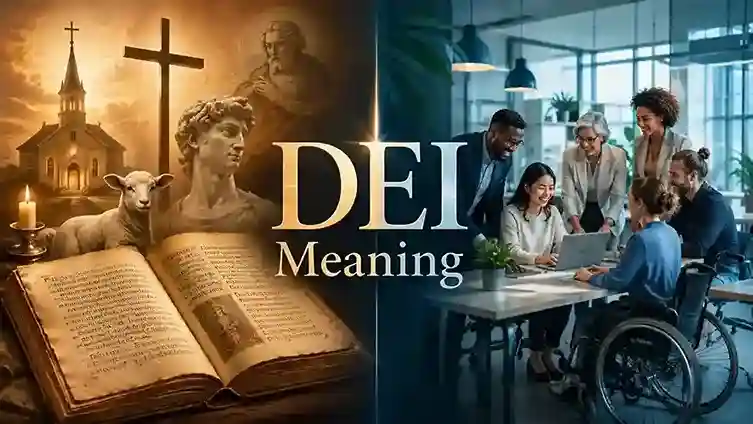
Search “dei meaning” and you’ll find results about religion, business, and politics tangled together in one confusing list. That mix leaves many readers more lost than when they started. This guide separates every definition clearly — from the Latin word “Dei” in Agnus Dei and Imago Dei, to the modern acronym DEI for Diversity, Equity, and Inclusion. By the end, you’ll know exactly which meaning fits your search.
What Does DEI Mean? A Quick Answer
The dei meaning depends entirely on context, and that single fact causes most of the confusion online. The Latin genitive form of “Deus,” “Dei” means “of God.” It appears in religious expressions such as Imago Dei and Agnus Dei.
DEI, written in capital letters, is an acronym instead of a Latin word. It stands for Diversity, Equity, and Inclusion, and it describes workplace and government policies designed to create fairer opportunities for everyone.
Both terms look identical in a search bar. Only the context around them reveals which one a person actually needs.
The Two Completely Different Meanings of “Dei”
Recognizing that these are two unrelated words that just so happen to share four letters is the first step towards comprehending the entire meaning of dei.
- Lowercase “dei” — A Latin word meaning “of God,” used in religious phrases and Church Latin.
- Uppercase “DEI” — An English acronym for Diversity, Equity, and Inclusion, used in business, government, and political discussions.
One traces back over two thousand years to ancient Rome. The other emerged from workplace policy discussions in the last few decades. Knowing which one you’re researching saves time and prevents mixing up two very different topics.
Dei Meaning in Latin: Understanding “Of God”
In classical Latin, “Deus” means “God.” “Dei” is simply the genitive case, which shows possession — much like adding “‘s” in English. So “Dei” translates to “God’s” or “of God.”
Catholic and Christian liturgy uses this word constantly. Priests, scholars, and hymn writers rely on it to build phrases that describe something belonging to or coming from God. This grammatical root explains why so many religious terms share the same ending.
Three phrases account for most searches around this meaning: Agnus Dei, Imago Dei, and Opus Dei. Each one uses “Dei” in a different but related way.
Agnus Dei Meaning: Lamb of God Explained
The literal translation of Agnus Dei is “Lamb of God.” Drawing from the Gospel of John, where John the Baptist is mentioned, it is one of the earliest titles for Jesus Christ in Christian history. refers to Jesus as God’s Lamb who atones for human sin.
The phrase also names a specific part of the Catholic Mass. During this moment, the congregation repeats the words three times as a prayer for mercy and peace before receiving Communion.
Composers throughout history — including Mozart, Bach, and Barber — have written musical settings titled “Agnus Dei.” These pieces remain popular in choirs and concert halls today, well beyond church settings.
Imago Dei Meaning: Made in God’s Image
Imago Dei means “image of God.” The phrase comes from the Book of Genesis, where scripture states that God created humanity in His own image and likeness.
This idea shapes core beliefs across Christianity, Judaism, and related faith traditions. It suggests every person carries inherent dignity and worth, regardless of background, status, or ability, because that worth comes directly from being made in God’s image.
Theologians, ethicists, and even some human rights advocates reference Imago Dei when discussing why human life deserves respect and protection. It remains one of the most quoted Latin theological phrases in modern sermons and academic writing.
Opus Dei Meaning: The Catholic Organization
Opus Dei translates to “Work of God.” Unlike the other phrases on this list, it refers to a specific organization rather than a general concept.
Founded in Spain in 1928 by St. Josemaría Escrivá, Opus Dei is a personal prelature within the Catholic Church. Its members — both clergy and laypeople — aim to find holiness through everyday work and ordinary life rather than through monastic withdrawal from the world.
The organization gained wider public attention after appearing in popular fiction, which sparked curiosity about its actual teachings and structure. In reality, Opus Dei operates as a recognized part of the Catholic Church with its own leadership, spiritual formation programs, and global membership.
Dei Meaning in the Bible: Key Verses and Context
The dei meaning in the Bible connects to several foundational passages, even though most English translations render “Dei” into English rather than keeping the Latin.
- Genesis 1:27 — The verse describing humanity’s creation in God’s image, the biblical root of Imago Dei.
- John 1:29 — Where Jesus is first called the “Lamb of God,” the biblical root of Agnus Dei.
- Romans 8 — A passage often cited in discussions of human dignity and God’s ongoing work in believers’ lives.
Latin Bible translations, particularly the Vulgate, use “Dei” throughout these passages. Scholars studying Church history or reading Latin liturgical texts encounter the word constantly, which is why it remains relevant well beyond ancient history classes.
DEI Meaning: Diversity, Equity, and Inclusion Explained
Now for the second, entirely separate definition. The dei meaning diversity equity inclusion refers to a framework organizations use to build fairer environments for employees, students, and communities.
Each word carries a distinct purpose:
- Diversity — Representation across race, gender, age, ability, background, and perspective within a group.
- Equity — Fair treatment and access, adjusted for the different starting points people begin with.
- Inclusion — Creating an environment where diverse individuals feel genuinely valued and able to participate fully.
Together, these three principles guide hiring practices, training programs, and organizational culture in workplaces, schools, and government agencies across the world.
Dei Meaning in Business: Why Companies Use It
Companies adopt DEI programs to build teams that reflect the customers and communities they serve. The dei meaning in business centers on three practical goals: broader talent pools, stronger employee retention, and better decision-making through varied perspectives.
Common business DEI initiatives include:
- Structured, bias-reduced hiring processes
- Employee resource groups for underrepresented staff
- Pay equity audits and transparent salary bands
- Mentorship and leadership development programs
- Regular training on inclusive management practices
Human resources departments often assign a dedicated DEI officer or team to track these programs and report progress to leadership. Results vary by company, and measuring true impact remains an ongoing challenge across the corporate world.
Dei Meaning in Government: Policies and Programs
Government agencies apply DEI principles differently than private companies, since public institutions serve entire populations rather than customer bases. The dei meaning in government typically involves hiring practices, contracting rules, and service delivery standards.
Federal, state, and local agencies have historically used DEI offices to review policies for unintended bias, expand outreach to underserved communities, and set accessibility standards for public services. The scope and funding of these offices shift frequently based on changing administrations and legislation.
Because government DEI policy affects public budgets and legal frameworks, it draws far more scrutiny and debate than similar programs inside private businesses.
Dei Meaning in Politics: The Debate Explained
Few three-letter acronyms generate as much political disagreement as DEI. Over the past few years, the definition of dei in politics has changed from being primarily an administrative HR phrase to a significant topic of public discussion.
Supporters argue DEI programs correct long-standing barriers to opportunity and create more representative institutions. Critics argue some programs prioritize identity categories over merit, or create new forms of unfairness while attempting to fix old ones.
Both political parties in the United States and other countries have proposed legislation either expanding or restricting DEI programs in government and education. This ongoing debate is a major reason so many people search for a clear, neutral definition instead of relying on partisan commentary.
DEI vs Dei: Complete Comparison Table
This table breaks down every major dei meaning side by side for quick reference.
| Term | Language/Origin | Literal Meaning | Common Usage | Where You’ll See It |
| Dei (lowercase) | Latin | “Of God” | Religious and liturgical phrases | Church texts, hymns, theology |
| Agnus Dei | Latin | “Lamb of God” | Title for Jesus Christ | Catholic Mass, classical music |
| Imago Dei | Latin | “Image of God” | Human dignity and worth | Theology, ethics discussions |
| Opus Dei | Latin | “Work of God” | Catholic organization name | Religious institutions, media |
| DEI (uppercase) | English acronym | Diversity, Equity, Inclusion | Workplace and social policy | Business, government, politics |
Common Misconceptions About DEI Meaning
Confusion around this term rarely comes from bad intentions — it comes from two unrelated words sharing the same letters. A few corrections clear up most misunderstandings.
- “Dei” is not always religious. The uppercase acronym has no connection to Latin or theology at all.
- DEI is not one single program. Every organization designs its own version, so specifics vary widely.
- Opus Dei is not secret. It’s a publicly recognized part of the Catholic Church with published teachings.
- DEI is not exclusive to any one country. Versions of workplace diversity policy exist worldwide under different names.
One can quickly determine which definition applies by comparing the context of a religious scripture with a commercial item.
FAQs
1. What is the simple dei meaning in one sentence?
Lowercase “dei” is Latin for “of God,” while uppercase “DEI” stands for Diversity, Equity, and Inclusion — two unrelated terms that happen to share the same spelling.
2. What is the imago dei meaning in plain English?
Imago Dei, which translates to “image of God,” is the idea that all people are created in God’s image and hence have intrinsic value and dignity.
3. What is the opus dei meaning and is it a secret society?
Opus Dei, which translates to “Work of God,” is an official Catholic organization that functions in public with distinct leadership and teachings. It is not a hidden society.
4. What is the agnus dei meaning in the Catholic Mass?
Agnus Dei means “Lamb of God” and refers to both a title for Jesus Christ and a specific prayer recited during Communion in the Catholic Mass.
5. What does DEI mean in a job or workplace setting?
In a workplace, DEI refers to Diversity, Equity, and Inclusion policies that guide hiring, pay fairness, and creating an environment where all employees feel valued.
6. Why is DEI meaning debated in politics right now?
The definition of DEI is disputed since proponents believe it will address historical injustice, while detractors contend that certain initiatives raise new issues of fairness, resulting in continuing legislation and public discourse.
Conclusiin
Two letters, one spelling, two entirely different worlds — that’s the real story behind dei meaning. Whether you arrived here for a theology paper, a Sunday homily, a workplace policy, or a political debate, you now have a clear, accurate answer instead of a jumbled search results page.