
Key Takeaways from the EasyJet Flight U2238 Emergency Landing Newcastle
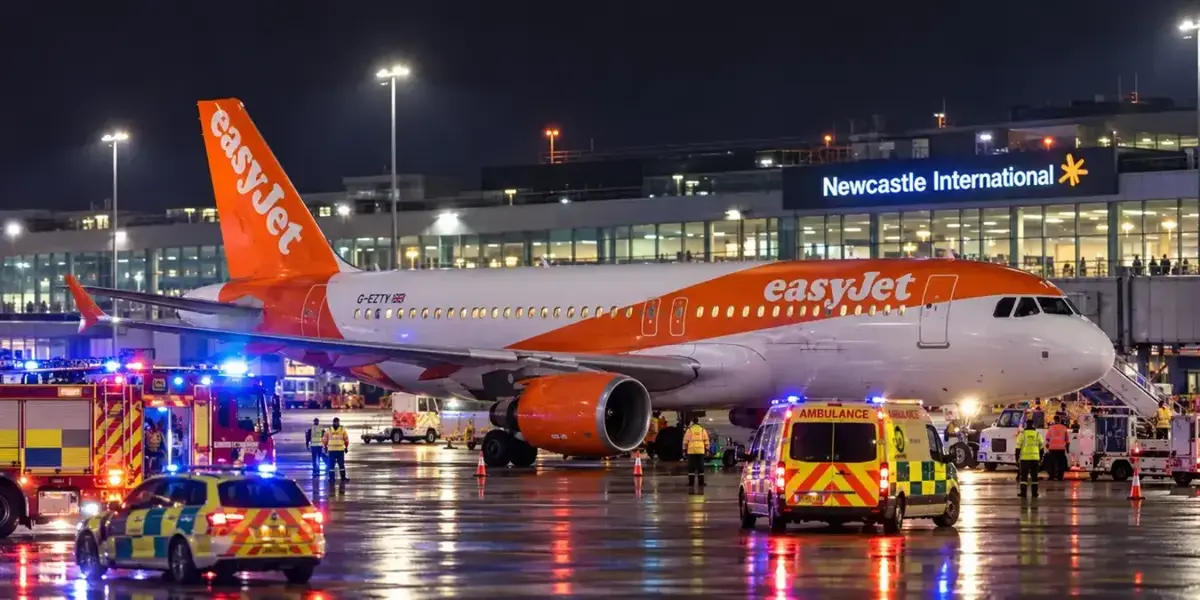
An easyJet flight from Copenhagen to Manchester made an unexpected stop at Newcastle Airport on October 27, 2025. The reason was not mechanical failure or weather. In the middle of the flight, a passenger required immediate medical assistance. The crew acted fast, declared an emergency, and landed safely within minutes.
This article breaks down exactly what happened on the EasyJet Flight U2238 Emergency Landing Newcastle incident, the aircraft involved, and what this event tells us about in-flight medical emergencies.
What Happened on EasyJet Flight U2238?
The flight, operating as EZY2238 (also referenced as U2238 or U22238), departed Copenhagen Airport at approximately 10:00 PM local time on October 27, 2025. Its destination was Manchester Airport, with a scheduled arrival around 10:45 PM UK time.
While cruising over the North Sea, the flight crew declared a general emergency, squawking transponder code 7700. This code alerts air traffic control that the aircraft requires immediate priority handling. The pilot then initiated a direct diversion to Newcastle Airport (NCL).
The aircraft landed safely at Newcastle at approximately 10:45–10:52 PM local time. Paramedics from the North East Ambulance Service were already waiting on the tarmac.
Why Did the Flight Divert? The Medical Emergency Explained
The diversion was triggered by a passenger onboard who required “urgent medical attention”. EasyJet’s official statement confirmed this directly: “Flight EZY2238 from Copenhagen to Manchester on October 27 diverted to Newcastle, due to a customer onboard requiring urgent medical attention”.
According to North East Ambulance Service, a call was received at 10:33 PM reporting a person unwell at Newcastle Airport. One ambulance crew was dispatched, and the patient was transported to the Royal Victoria Infirmary (RVI) in Newcastle for further treatment.
The nature of the medical condition was not publicly disclosed by easyJet or emergency services. The airline emphasized that “the safety and wellbeing of our customers and crew is always easyJet’s highest priority”.
Flight Timeline: From Copenhagen to Newcastle and Beyond
Here is the precise sequence of events based on multiple aviation sources:
| Time (Local UK) | Event |
| ~10:00 PM | Flight departs Copenhagen Airport |
| ~10:20 PM | Crew squawks 7700 emergency code over North Sea |
| ~10:33 PM | Ambulance service receives call about unwell passenger |
| ~10:45–10:52 PM | Aircraft lands at Newcastle Airport |
| ~11:00 PM | Passenger transferred to RVI hospital |
| 12:02 AM (Oct 28) | Flight departs Newcastle for Manchester |
| ~12:29 AM | Aircraft lands at Manchester Airport |
The entire diversion added roughly 77 minutes to the journey. After the passenger was handed over to medical services, the flight refueled and continued to Manchester.
Aircraft Details: The Airbus A320 Involved
The aircraft operating this flight was an Airbus A320-200 registered as G-EZPB. Key specifications:
| Feature | Detail |
| Aircraft Type | Airbus A320-200 |
| Registration | G-EZPB |
| Age at Incident | Approximately 9.7 years |
| Entered Service | February 2016 |
| Operator | easyJet UK |
The A320-200 is a narrow-body, twin-engine jet widely used for short to medium-haul routes across Europe. This particular aircraft has been in continuous service with easyJet since delivery.
Understanding Transponder Code 7700: Why It Matters
When the crew of EasyJet Flight U2238 declared an emergency, they set their transponder to squawk 7700. This four-digit code is universally recognized by air traffic control systems worldwide.
What squawking 7700 does:
- Alerts all nearby ATC facilities that the aircraft has an emergency
- Grants the flight priority handling and cleared routing
- Triggers automatic notification to emergency services at the destination airport
- Ensures other aircraft in the area are vectored away if necessary
In this case, the emergency was medical rather than mechanical. The crew still followed standard protocol because a passenger’s life was potentially at risk. Speed mattered.
Newcastle Airport’s Role in the Emergency Response
Newcastle International Airport (IATA: NCL) handled the diversion efficiently. The airport is located approximately 6 miles northwest of Newcastle city center and serves as a regional hub for northeast England.
When the emergency was declared, Newcastle Airport coordinated with:
- North East Ambulance Service – dispatched an ambulance crew to the tarmac
- Air traffic control – cleared the aircraft for direct approach
- EasyJet ground staff set up fueling for the subsequent flight.
The Royal Victoria Infirmary, where the patient was taken, is a major teaching hospital with emergency facilities, located roughly 15 minutes from the airport.
How EasyJet Handled the Incident
EasyJet’s response followed standard airline protocols for in-flight medical emergencies. The airline issued a consistent statement to multiple media outlets:
On October 27, flight EZY2238 from Copenhagen to Manchester was diverted to Newcastle because a passenger needed immediate medical assistance. The customer was welcomed by medical staff upon arrival, and the flight continued to Manchester. The safety and welfare of our customers and staff are always EasyJet’s top priorities.
Passengers onboard were informed of the diversion via an update that described it as a “passenger welfare issue” and classified the disruption as an “extraordinary circumstance”. This classification matters for passenger rights, as extraordinary circumstances can affect compensation eligibility under UK/EU regulations.
What This Incident Reveals About In-Flight Medical Emergencies
Most passengers are unaware of the frequency of medical incidents on commercial aircraft. Industry data suggests approximately 1 in every 600 flights involves some form of medical event, though most are minor.
Common in-flight medical situations include:
- Cardiac events (chest pain, suspected heart attacks)
- Respiratory issues (asthma attacks, allergic reactions)
- Neurological events (seizures, strokes)
- Gastrointestinal distress
- Injuries from turbulence
Airlines train cabin crew in basic first aid and carry medical kits onboard. When a situation exceeds crew capabilities, pilots will divert if the passenger’s condition is serious enough.
The choice to change course is seldom made hastily. It involves:
- Consultation with ground-based medical advisors (often via satellite link)
- Assessment of the passenger’s condition by any medical professionals onboard
- Consideration of flight time remaining versus time to nearest suitable airport
- coordination with emergency services and air traffic control
In the case of EasyJet Flight U2238, the decision was made while over the North Sea, making Newcastle the logical diversion point given its proximity to the flight path.
Passenger Rights After a Medical Diversion
If you experience a diversion due to a medical emergency, here is what you should know:
What you are typically entitled to:
- Rebooking on the next available flight if the diversion causes you to miss a connection
- Refreshments if the delay exceeds certain thresholds
- Accommodation if an overnight stay becomes necessary
What may not apply:
- Cash compensation under UK261/EU261 regulations may not apply if the airline classifies the event as an “extraordinary circumstance”
- Medical emergencies are generally considered outside the airline’s control
The flight in this case continued to Manchester the same night, so passengers reached their original destination with a delay of roughly 1-2 hours.
Key Takeaways from the EasyJet U2238 Incident
For travelers:
- Medical emergencies can happen on any flight, regardless of airline or route
- Crews are taught to put safety before timeliness.
- Diversions are rare but necessary when a passenger’s life is at risk
For aviation observers:
- The response followed standard emergency protocols (7700 squawk, direct routing, ground coordination)
- Newcastle Airport proved capable of handling unexpected diversions efficiently
- EasyJet communicated clearly and consistently through official channels
The human element:
- A passenger received timely medical care
- Fellow travelers cooperated with the disruption
- After the medical issue was rectified, the flight safely finished its route.
Conclusion
The EasyJet Flight U2238 Emergency Landing Newcastle event was a textbook example of how airlines handle in-flight medical crises. A passenger needed help. The crew responded. The plane landed safely. Medical professionals took over. The flight continued.
It is a reminder that air travel involves hundreds of decisions every hour, and sometimes the most important decision is to land as soon as possible. The system worked as designed.
Featured Guides
Hand‑picked stories you don’t want to miss

Percentage Calculators Hub: Quick & Accurate Math Tools
All the percentage calculators you need in one place — from discounts to tips and more.
Read Guide
Tech Guru WaveTechGlobal Guide: Insider Tips & Reviews
Your go‑to resource for the latest gadgets, software, and expert tech advice.
Read Guide
Hard Part Haircut Guide: Styles, Tips & Barber Secrets
Master the sharp hard part — from classic side parts to modern fades and maintenance.
Read Guide