What Is HRMTaila? The AI HR Platform Changing Workforce Management
Your HR team drowns in spreadsheets every Monday morning. Resumes pile up. Payroll errors trigger angry emails. Employee complaints slip through the cracks because nobody has time to track them. The old way of managing people is broken.
This guide explains exactly how AI-driven HR technology fixes these problems and gives your team the breathing room they need to focus on real work.
What Exactly Is HRMTaila and How Does It Work?
HRMTaila is an AI-powered human resource management platform designed to automate the repetitive tasks that drain HR departments. The system uses machine learning algorithms to handle recruitment screening, payroll processing, performance reviews, and employee engagement from a single dashboard.
Instead of juggling five different software tools, companies plug everything into one centralized system. The AI layer learns from your organization’s data patterns and starts making smarter suggestions over time — from flagging flight-risk employees to predicting seasonal hiring needs.
| Component | Function | Technology Used |
| Recruitment Module | Resume screening and candidate ranking | Natural Language Processing |
| Payroll Engine | Salary calculation and tax compliance | Automated rule-based AI |
| Performance Tracker | Goal setting and review cycles | Predictive analytics |
| Engagement Hub | Surveys, feedback, and recognition | Sentiment analysis |
| Attendance System | Leave and shift management | Biometric and GPS integration |
Why Are Companies Switching to AI-Powered HR Tools?
Manual HR processes cost mid-size companies an average of $1,400 per employee annually in administrative overhead, according to the Society for Human Resource Management (SHRM) [1]. That number climbs when you factor in compliance fines, hiring delays, and turnover caused by poor employee experiences.
AI-driven platforms eliminate these hidden costs by processing data faster and more accurately than any human team could manage alone. The shift is not about replacing HR professionals. It frees them to handle strategy, culture building, and complex employee relations — the work that actually requires human judgment.
| Traditional HR Pain Point | AI Solution | Time Saved |
| Manual resume screening | AI ranks candidates in seconds | 75% reduction |
| Payroll miscalculations | Automated tax and deduction rules | 90% fewer errors |
| Annual review bottlenecks | Continuous performance tracking | 60% faster cycles |
| Compliance paperwork | Real-time regulatory updates | 40+ hours per quarter |
| Employee turnover surprises | Predictive flight-risk alerts | 30% better retention |
Core Features That Set This Platform Apart
The platform packs several modules that work together rather than operating in isolation. Each feature connects to a shared employee database, so information flows seamlessly between departments without duplicate data entry.
The AI engine sits at the center of every module. It reads patterns across hiring, performance, attendance, and engagement data to surface insights that would take a human analyst weeks to uncover.
| Feature | What It Does | Who Benefits Most |
| Smart Hiring Pipeline | Screens, scores, and schedules candidates | Recruitment teams |
| One-Click Payroll | Calculates salaries, taxes, and benefits | Finance and HR |
| 360° Reviews | Collects peer, manager, and self-assessments | Team leads |
| Leave Management | Tracks PTO, sick days, and approvals | All employees |
| Document Vault | Stores contracts, IDs, and policies securely | Compliance officers |
| Chatbot Assistant | Answers employee HR questions instantly | Entire workforce |
How Does the AI Recruitment Module Save Hiring Time?
Recruiting eats up more HR bandwidth than almost any other function. A single job posting can generate hundreds of applications, most of which do not match the role requirements. Sorting through them manually takes days.
The AI recruitment engine reads every resume, matches skills against the job description, and ranks candidates by fit score within minutes. It also removes identifying details like names, photos, and addresses to reduce unconscious bias during the initial screening stage.
| Recruitment Step | Manual Process | AI-Assisted Process |
| Resume collection | 2–3 days | Instant |
| Initial screening | 5–7 days | Under 1 hour |
| Candidate shortlisting | 2–3 days | 30 minutes |
| Interview scheduling | 3–5 days of back-and-forth | Automated in minutes |
| Offer letter generation | 1–2 days | Same day |
| Total time-to-hire | 30–45 days | 10–18 days |
Employee Performance Tracking Made Simple
Annual performance reviews feel outdated the moment they end. By the time a manager sits down with an employee in December, the feedback from March is already forgotten. Continuous tracking solves this problem entirely.
The platform lets managers set quarterly goals, log real-time feedback, and pull performance dashboards at any point during the year. Employees see their own progress metrics, which builds accountability without micromanagement.
| Review Type | Frequency | Data Points Tracked |
| Goal Check-ins | Weekly or biweekly | Task completion rate |
| Peer Feedback | Monthly | Collaboration scores |
| Manager Assessment | Quarterly | KPI achievement |
| Self-Review | Quarterly | Personal development goals |
| Annual Summary | Yearly | Comprehensive performance score |
Payroll Automation and Compliance Handling
Payroll mistakes destroy employee trust faster than almost anything else. A wrong tax deduction or a missed overtime payment sends people straight to the HR office — and sometimes to a lawyer.
The payroll engine pulls attendance data, leave records, and tax regulations automatically. It calculates gross-to-net pay for every employee, generates payslips, and files statutory reports without manual intervention. When tax laws change, the system updates its rules overnight.
| Payroll Task | Manual Method | Automated Method |
| Attendance import | Excel upload | Real-time sync |
| Tax calculation | Spreadsheet formulas | Auto-updated rules |
| Overtime computation | Manual counting | System-detected |
| Payslip distribution | Email or print | Employee portal |
| Statutory filing | Accountant-dependent | Auto-generated forms |
| Error rate | 5–8% | Below 0.5% |
Workforce Analytics and Real-Time Reporting
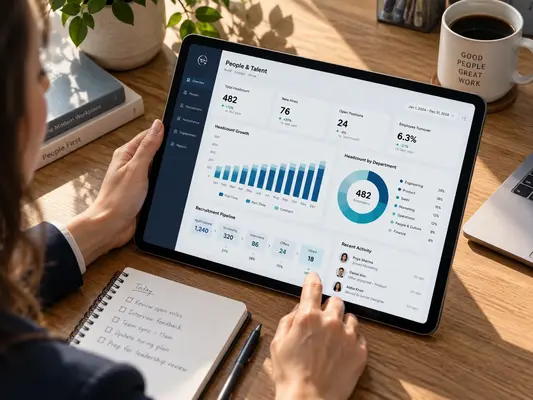
Data without context is just noise. The analytics dashboard transforms raw HR numbers into clear visual reports that leadership teams can actually use for decision-making.
You can track headcount trends, department-wise attrition, hiring funnel conversion rates, and diversity metrics from a single screen. The AI layer highlights anomalies — like a sudden spike in resignations from one department — before they become full-blown crises.
| Report Type | Key Metrics | Update Frequency |
| Headcount Summary | Total employees, new hires, exits | Daily |
| Attrition Analysis | Voluntary vs. involuntary turnover | Monthly |
| Hiring Funnel | Application-to-offer conversion | Weekly |
| Diversity Dashboard | Gender, age, ethnicity breakdown | Quarterly |
| Cost-per-Hire | Recruitment spend per role | Monthly |
| Absenteeism Trends | Sick days, unplanned leave | Weekly |
Employee Engagement and Retention Tools
Replacing an employee costs roughly 50–200% of their annual salary, according to Gallup’s workplace research [2]. Keeping good people is cheaper than finding new ones, yet most companies only measure engagement once a year through a lengthy survey nobody wants to fill out.
The platform runs short pulse surveys every two weeks, analyzes sentiment in real time, and flags departments where morale is dropping. Managers receive actionable suggestions — not just raw scores — so they know exactly what to fix.
| Engagement Tool | Purpose | Frequency |
| Pulse Surveys | Quick mood and satisfaction checks | Biweekly |
| Recognition Board | Peer-to-peer shoutouts and rewards | Ongoing |
| One-on-One Templates | Structured manager-employee conversations | Weekly |
| Exit Interview Analysis | Identifies patterns in why people leave | Per departure |
| Wellness Check-ins | Mental health and workload monitoring | Monthly |
Integration Capabilities with Existing Business Software
No company wants to rip out its entire tech stack to adopt a new HR tool. The platform connects with popular business applications through pre-built APIs and webhooks, so data flows between systems without manual transfers.
Whether your team uses Slack for communication, QuickBooks for accounting, or Microsoft Teams for meetings, the integration layer keeps everything synchronized. Setup typically takes a few hours rather than weeks.
| Integration Category | Supported Platforms | Setup Time |
| Communication | Slack, Microsoft Teams, Zoom | 1–2 hours |
| Accounting | QuickBooks, Xero, Tally | 2–4 hours |
| Project Management | Asana, Jira, Trello | 1–2 hours |
| Identity Management | Okta, Azure AD, Google Workspace | 2–3 hours |
| ATS Tools | Greenhouse, Lever, Workday | 3–5 hours |
| Custom APIs | Any REST-based system | Developer-dependent |
Pricing Structure and Plans for Different Business Sizes
Pricing scales with your headcount so startups do not pay enterprise rates and large organizations get volume discounts. Most plans include a free trial period so you can test the platform before committing.
| Plan | Employee Range | Monthly Cost (Approx.) | Key Inclusions |
| Starter | 1–25 | $3–5 per user | Payroll, attendance, basic reports |
| Growth | 26–100 | $5–8 per user | Full recruitment, performance, analytics |
| Enterprise | 101–500 | $8–12 per user | Custom integrations, dedicated support |
| Unlimited | 500+ | Custom quote | On-premise option, SLA guarantees |
How Does It Compare to Traditional HR Software?
Legacy HR systems were built for record-keeping, not intelligence. They store data but do nothing with it. The AI layer in modern platforms like this one turns passive databases into active decision-support tools.
| Comparison Factor | Traditional HR Software | AI-Powered HR Platform |
| Data processing | Manual entry and retrieval | Automated and predictive |
| Recruitment speed | Weeks to months | Days to weeks |
| Payroll accuracy | Prone to human error | Near-zero error rate |
| Employee insights | Annual survey only | Continuous real-time data |
| Compliance updates | Manual research required | Automatic rule changes |
| User experience | Clunky, outdated interfaces | Modern, mobile-friendly |
| Scalability | Expensive to expand | Grows with your team |
Security, Data Privacy, and Compliance Standards
Employee data includes social security numbers, bank details, medical records, and performance evaluations. A breach here carries legal consequences far beyond a typical data leak.
The platform encrypts all data at rest and in transit using AES-256 encryption. It complies with GDPR, CCPA, and SOC 2 Type II standards. Role-based access controls ensure that managers only see the data they need — nothing more.
| Security Feature | Standard Met |
| Data Encryption | AES-256 at rest and in transit |
| Access Control | Role-based with multi-factor authentication |
| Compliance | GDPR, CCPA, SOC 2 Type II |
| Audit Logs | Full activity tracking for 7 years |
| Data Residency | Region-specific server options |
| Backup Frequency | Automated every 6 hours |
The U.S. Department of Labor provides detailed guidelines on employee data handling requirements that modern HR platforms must meet [3].
Real User Experiences and Measurable Results
Companies that adopt AI-driven HR management typically see measurable improvements within the first quarter. The most common wins include faster hiring, fewer payroll disputes, and higher employee satisfaction scores.
| Metric | Before Implementation | After 6 Months |
| Average time-to-hire | 42 days | 16 days |
| Payroll error rate | 6.2% | 0.3% |
| Employee satisfaction | 62% | 81% |
| HR admin hours per week | 35 hours | 12 hours |
| Voluntary turnover | 22% annually | 14% annually |
| Compliance audit findings | 8–12 per year | 0–2 per year |
Frequently Asked Questions
What is HRMTaila used for?
This AI-powered HR platform automates recruitment, payroll, performance management, attendance tracking, and employee engagement. It replaces multiple disconnected tools with one intelligent system that learns from your company’s data and improves over time.
Is the platform suitable for small businesses?
Yes. The Starter plan supports teams as small as five employees with essential payroll and attendance features. Small businesses often benefit the most because they lack dedicated HR staff and need automation the most.
How long does implementation take?
Most companies complete full setup within two to four weeks. Basic modules like attendance and payroll go live within days. Advanced features like AI recruitment and custom analytics may take an additional two weeks to configure.
Does it handle multi-country payroll?
The Enterprise and Unlimited plans support multi-country payroll with localized tax rules for over 40 countries. The system automatically adjusts calculations based on each employee’s work location and applicable labor laws.
Can employees access the platform on mobile?
Yes. The mobile app works on both iOS and Android devices. Employees can check payslips, request leave, complete surveys, and message HR directly from their phones without needing a desktop computer.
What happens to our data if we cancel?
Your data belongs to you. Upon cancellation, the platform provides a complete data export in standard formats (CSV, PDF, JSON) within 30 days. After the export window closes, all records are permanently deleted from their servers per GDPR requirements.
Conclusion
Your people deserve better than broken spreadsheets and forgotten follow-ups. The technology to fix these problems already exists, and waiting another year only costs you more money, more talent, and more trust.
Start with a free trial. Run your next hiring cycle through the AI pipeline. Watch your payroll errors drop to near zero. The results speak louder than any feature list ever could.
Your HR team is ready for this upgrade. Give them the tools they need and watch your entire organization move faster.