
TheLaptopAdviser Expert Gaming: The 2026 Playbook for Raw Power
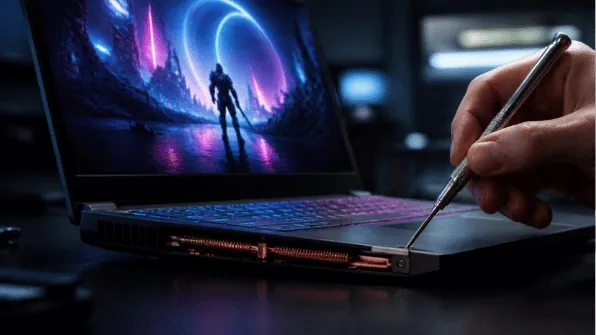
You have been lied to. The sticker price on that shiny new gaming laptop is not the real cost. The real cost is the silent bottleneck you will discover six months later when your FPS drops below 60 during a critical ranked match.
This is where the TheLaptopAdviser expert gaming methodology changes everything. It is not about buying the most expensive rig. It is about buying the smartest rig. We are stripping away the marketing fluff and diving deep into the hardware trenches. By the time you finish this expert reviews thelaptopadviser breakdown, you will know exactly where to spend your money and where to save it.
The Brutal Truth About “Gaming” Labels
Walk into any electronics store, and every machine glows with RGB lighting. Every box screams “Pro” and “Ultimate.” It is a minefield designed to confuse you. The manufacturers do not want you to look at the fine print.
They want you to see a high-end graphics card name and ignore the cheap motherboard. They want you to focus on the Core i9 label while hiding the fact that the cooling system cannot sustain that speed for more than ten minutes. This is why generic buying advice fails hard. You need an expert review thelaptopadviser approach that looks at the chassis, the wattage, and the thermal interface, not just the badge.
Expert Reviews TheLaptopAdviser: Deep Dive into Hardware
The laptop market is a game of compromises. To win the game, you must understand the three pillars of performance. Ignore one, and the whole system collapses like a house of cards.
The GPU Trap: Wattage Beats Model Numbers
Everyone asks, “Do you have an RTX 4070?” The smarter question is, “How many watts does that RTX 4070 pull?”
A low-wattage RTX 4080 can actually lose to a high-wattage RTX 4070. Laptop manufacturers often shove powerful chips into thin chassis to look good on paper. However, without proper power delivery, the chip throttles.
- Full Power (Max-TGP): These are heavy laptops that scream. They need big power bricks.
- Low Power (Max-Q): These are thin and quiet but often deliver 30% less performance than their chunky siblings.
Always check the Total Graphics Power (TGP) before buying. It is the single biggest factor in real-world gaming performance.
The Thermal Ceiling: Why Your Laptop Slows Down
Imagine running a marathon in a winter coat. That is what gaming on a poorly ventilated laptop feels like. Your CPU hits 95 degrees Celsius, and the system slams on the brakes to prevent a meltdown.
This is the “thermal ceiling.” The TheLaptopAdviser buyer guide philosophy insists that cooling is just as important as the CPU. You are not buying a processor; you are buying the ability to sustain that processor’s speed for three hours straight.
Look for vapor chambers, multiple heat pipes, and decent exhaust airflow. If the keyboard deck gets hot enough to fry an egg, you are losing performance.
TheLaptopAdviser Expert Review: Screen Quality Matters
You are spending thousands of dollars on hardware to render pixels at lightning speed. Why are you looking at those pixels on a dull, washed-out screen?
The display is the window to the game. It is the one component you interact with constantly. A slow response time creates ghosting, making fast-paced shooters look blurry.
Understanding Refresh Rates and Color
This is not just about 144Hz versus 240Hz. It is about color accuracy and brightness.
- The Esports Player: You need the highest refresh rate possible (240Hz+). Speed trumps visual fidelity.
- The Story Gamer: You want a QHD or 4K display with 100% DCI-P3 color gamut. You want the game to look like a painting.
Finding the balance is key. A bright, high-contrast screen will hide the weaknesses of mid-range hardware better than anything else.
TheLaptopAdviser Buyer Guide: Specs vs. Reality (Data Table)
To put this into perspective, let’s look at how specifications translate into actual gaming experiences based on the latest 2026 standards.
| Component | “Good” Tier | “Expert” Tier | Real-World Impact on Gaming |
| CPU | Intel i5 / Ryzen 5 | Intel i7 / Ryzen 7+ | Prevents stutter in open-world games and strategy titles. |
| GPU | RTX 4050 (Low TGP) | RTX 4070 (High TGP) | Determines max settings and ray tracing ability. |
| RAM | 16GB DDR4 | 32GB DDR5 | Helps with background tasks (Discord/Streaming) while gaming. |
| Storage | 512GB SSD | 1TB+ NVMe Gen4 | Faster load times; essential for massive 100GB+ game files. |
| Cooling | Dual Fan | Vapor Chamber | Prevents FPS drops during long gaming sessions. |
Analysis of the Data:
Notice that the “Expert” tier is not just about having the biggest numbers. It is about consistency. A high-end GPU with low RAM will still stutter when the system needs to swap assets. The TheLaptopAdviser expert reviews consensus is that balance beats raw peak performance every single time.
The Hidden Cost of Thin Design
We love thin laptops. They look sleek in a backpack and feel premium on a desk. But in the gaming world, thinness is the enemy of performance.
When a company shaves off millimeters, they shrink the fans. When they shrink the fans, they spin them faster. Faster fans are louder. Often, they are still not enough to cool the components, leading to that thermal throttle we discussed.
You are paying a premium for a thin laptop that performs worse than a cheaper, thicker laptop. Unless portability is your absolute top priority, choose airflow over aesthetics.
The Upgrade Trap (Soldered RAM)
Many modern laptops are moving toward soldered RAM. This means the memory is fused to the motherboard. You cannot upgrade it later.
This is a dangerous trend. A laptop with 16GB of soldered RAM might be fine today. But in three years, it will be a bottleneck. Always check if the laptop has a SODIMM slot for future upgrades. Future-proofing is a cornerstone of smart buying.
Frequently Asked Questions
Is TheLaptopAdviser expert gaming advice only for professionals?
No. The term “expert” refers to the depth of the advice, not the target audience. The expert reviews thelaptopadviser guidelines are designed to help beginners understand complex concepts so they don’t get ripped off. You do not need to be a tech wizard to follow the logic; you just need to value your money.
How much RAM do I truly need for gaming in 2026?
16GB is the absolute minimum for modern gaming if you plan to close every background app. However, the TheLaptopAdviser buyer guide strongly recommends 32GB. Games are pushing memory usage higher than ever, and if you like to have Chrome tabs, Discord, or Spotify open while you play, 32GB ensures smooth sailing.
Can I trust a laptop with a high-end GPU but a low price?
Usually, no. If the price seems too good to be true, look at the wattage and the build quality. A laptop might advertise an RTX 4080 but power-limit it to the point where it performs like an RTX 4070. Furthermore, the screen might be terrible, meaning you can’t even see the performance you are paying for.
Why is my laptop dying so fast when I unplug it from the wall?
Gaming laptops are not designed to game on battery power. The battery cannot supply the massive wattage required by the GPU and CPU at full speed. When you unplug, the system automatically throttles performance drastically to save power. For maximum FPS, you must always be plugged in.
What is the one spec I should never compromise on?
The GPU. It is the hardest component to upgrade later and dictates the overall gaming capability of the machine. You can live with a slightly older CPU, and you can often add RAM, but you are stuck with the GPU you buy.
Does screen resolution affect my CPU or GPU more?
It affects the GPU. Higher resolutions (like 1440p or 4K) shift the load onto the GPU. Lower resolutions (like 1080p) put more pressure on the CPU. If you have a weak CPU, playing at 1080p might actually be harder than playing at 1440p if your GPU is strong.
Conclusion
We have covered the pitfalls, the traps, and the data. The main takeaway from this TheLaptopAdviser expert gaming analysis is simple: stop looking at the model number sticker and start looking at the engineering.
A laptop is a symphony of parts. If the fans are weak, the orchestra falls silent. If the screen is dim, the picture is lost. Your job is to find the machine that harmonizes the GPU, the cooling, and the display.
Do not let the siren song of a “Max-Q” design trick you into buying a shadow of a desktop card. Buy the machine that runs cool, runs bright, and runs fast—not just for the first ten minutes, but for the next five years.